I Sleep Now
Second in the series: My Default Config Was Neurotypical
By: Casey Cannady : nomad, cybersecurity veteran & late-diagnosed AuDHD adult
TL;DR
Last week I published a rule about myself: I do not make phone calls, it is an accommodation and not an affectation, and it is the one I will defend the longest. Four days later an old coworker called me and we talked for thirty-seven minutes and I enjoyed all of them. So I got my own rule wrong in public, which turns out to be the most useful mistake in this series so far, because the real rule is not about phone calls. It is about who.
This post is the other half of the diagnosis: not the fight to get it, but what having it actually changed. Which was almost nothing about how I behave in public and almost everything about forty years of memory. Arguments with my father. Married too young, a spiteful ex who nearly ended me, and the two weeks I spent inpatient at Beckett Springs because of her decade long parental alienation campaign. A best friend I lost to his church and his Facebook feed. All of it re-read through a lens I did not have at the time. And underneath all of that, the least dramatic and most important thing on the list: I sleep now. Seven to eleven hours, most nights, after decades of four to six and two or three nights a week of none at all.
I did not start making accommodations after the diagnosis. I started calling them that, and then I finally added the ones I had never been allowed.
I Broke My Own Rule in Four Days
In last week's post I wrote this about myself, in bold, on my own website:
No phone calls. Email, SMS, or video. Voice-only calls burn processing capacity I need for the actual work, and I stopped apologizing for that. This is the accommodation people push back on hardest, and it is the one I will defend the longest.
Four days later my phone rang. It was an old coworker. I knew he might be calling, and I picked up. We talked for thirty-seven minutes, and he is calling me again when he gets back from a trip. I am looking forward to it!
So either I am a hypocrite or the rule was written wrong. It was written wrong, and the way it was wrong is worth more than the rule was.
Here is the correction. The cost of a phone call is not in the medium. It is in the person on the other end of it.
The ROI on a call with him is great. Low mental cost, high mental health return. I know him. I know his cadence, his humor, what he means when he pauses. There is no subtext to decode in real time and no performance required, so nothing is running in the background while we talk. That call costs me almost nothing and gives me a friend.
A call with a stranger, a client I have not built a model of yet, an unscheduled manager check-in, an insurance rep, a support line: those are expensive. Every one of them requires me to run live translation on tone and intent, with no transcript, no ability to reread, no pause to compose, and a social penalty for asking someone to repeat themselves. That is the part that burns the fuel. The phone is just where it happens most often.
I have spent nearly thirty years writing access control policy for a living, and I published a rule that denied by protocol when it should have denied by principal. That is a rookie mistake and I made it about my own head.
Which is the whole theme of this post. I have been running accommodations my entire adult life. I just described them badly, or did not describe them at all, because I did not have the vocabulary and because nobody had ever told me I was allowed to need them.
What a Word Does to Forty Years
People expect a late diagnosis to change your future. Mine barely touched my behavior. Well, my public-facing behavior. I still mask in public, and it is very hard to turn off. My internal behavior, and my behavior at home, are night and day. What the diagnosis did to the rest of me was reach backward.
I have replayed hundreds of conversations, fights, and moments through the new lens. Not to excuse myself. To finally read the transcript correctly. Three of them matter enough to publish.
My father telling me I would never amount to anything
That was a recurring fight, not a single event. And for four decades I filed it as a verdict on my character that I had to disprove by working harder than everyone in the room.
Read it again with the last post in mind. This is the same man who would not allow me to be tested, and who hit me on the head when I broke eye contact with an adult. He had already decided what I was and had already decided nobody would name it. “You will never amount to anything” was not a prediction about my potential. It was a man defending his own decision, out loud, to a child who had no way to check his work.
I built an entire career out of trying to falsify that sentence. Fortune 500 environments, federal-scale deployments, an Enterprise Architect title. It was never going to be enough, because the sentence was never about my output.
Married too young
I left the Purdue Varsity Glee Club after three years, and I did not leave because of the music. I left because I got engaged at twenty-one, and married at twenty-two, to a woman who I would now describe as a covert narcissist, and it went about as badly as that can go.
The specific fights I keep replaying are the ones where she swore to me that she was telling the truth, but my gut was screaming otherwise, and I dug my heels in and could not explain why. She would produce a perfectly reasonable account. I would have nothing to argue with except a certainty I could not source. So I became the unreasonable one, over and over, because I could not show my work.
Here is what I did not know then. Pattern recognition without a legible audit trail is one of the more common ways an autistic brain arrives at a correct answer. I was not being paranoid or controlling. In fact, I was one hundred percent right. She was cheating on me. I was doing exactly what I do professionally now, which is detect that something in a system does not reconcile long before I can produce the evidence that proves it. In a security review that instinct is why people hire me. In that marriage it was framed as my defect, and I accepted the framing, because I had no other word for what my head was doing.
There were children. When the marriage ended, she started a parental alienation campaign that ran for a decade, and it cost more than a quarter of a million dollars in legal fees, child support, insurance, court costs, and finally the cost of my own children being adopted by her new husband. I do not like talking about the ex or the children, so that is all I am going to say about the details. The part that belongs here is what it did to me.
It got bad enough that I ended up in a place I could not think my way out of. This was years after the marriage itself, with Karen beside me. I was having suicidal ideations. Karen made the call, and I was committed to Beckett Springs. Two weeks inpatient, and then roughly two more months outpatient after that.
I have written before about being in that building. What I could not write until now is why I think I got there, and it was not one manipulative person acting alone. It was a manipulative person operating on an undiagnosed autistic adult who had been trained since childhood to distrust his own read of a room. My father built that vulnerability. She found it. I had no name for any of it and therefore no defense against it.
The research is blunt about the neighborhood I was standing in. A 2021 paper out of Cambridge's Autism Research Centre opens with the numbers: up to 79% of autistic adults meet diagnostic criteria for a co-occurring psychiatric condition, and up to 66% have felt suicidal at some point in their life. A 2018 study of 164 autistic adults found that camouflaging predicted suicidality even after controlling for depression and anxiety, and a 2024 meta-analysis notes that autistic people describe camouflaging as exhausting, potentially leading to burnout and suicidal ideation.
I was not an outlier. I was a statistic that nobody had bothered to count, because nobody had bothered to test me.
My “best friend”
He was my best friend. He also worked at HCL Software, in a different group, and he was one of two people who knew I was throwing up every Monday before work.
I lost him to his church and his Facebook feed. That is the shortest and most honest way I can put it. Over a few years the person on the other end of our conversations was steadily replaced by whatever he had been fed that week, and eventually there was nothing left to talk to.
He is not the only one. There were two.
The re-read here is uncomfortable and it is aimed at me, not him. I held on far longer than I should have, because a friendship that already worked was infrastructure I could not easily rebuild. Making a new close friend as a masking autistic adult is not a weekend project. It is years of exhausting performance before the performance can safely stop. So I tolerated a great deal in order to avoid paying that cost again, and I told myself that was loyalty.
It was not loyalty. It was a shortage.
These three are the biggest re-reads, but they are not the only ones. I run nearly every interaction I have ever had through the same new lens, and most of them come back reading differently than they did the first time.
Cannabis, and Why I Am Bored of Explaining It
I want to be precise and then I want to move on. I am bored of explaining this because the explanation never changes and the questions never stop. It is the part people fixate on and it is not actually the interesting part.
Cannabis is medicine to me. It is not a drug I use to have fun.
I rarely drink alcohol. I have never smoked a cigarette in my life. I vape cannabis, and I do it for two documented, unglamorous reasons: severe chronic pain management, and slowing my brain down enough to be present.
That second one deserves a description, because “it calms me down” is uselessly vague. Without it, my AuDHD runs like several hundred independent thoughts all competing for primary attention at once. Not racing thoughts in the anxiety sense. Parallel processes, all live, all requesting the same single-threaded resource. It is extremely busy in here. Cannabis lowers the priority of some threads and the number of competing processes enough that I can actually be in the room with my wife instead of in the room with my own scheduler.
I was in Ohio's medical marijuana program for several years. Then we relocated to Texas via the Escapees domicile program, and I was enrolled in the Texas Compassionate Use Program for one year, 2024 to 2025. We could not afford to renew it the last time we were back in Texas, because of the bankruptcy.
Here is the part about Texas that actually matters, and it is not the politics. Texas treats THC concentrate as a Penalty Group 2 controlled substance, and concentrate is all I use: 510 distillate cartridges and RSO darts. Depending on where I am in a three to four month stock rotation, I have somewhere between twenty grams and well over a hundred grams on hand. Under Section 481.116 of the Texas Health and Safety Code, possession of four to four hundred grams of a Penalty Group 2 substance is a second degree felony, graded by aggregate weight including adulterants and dilutants, and a second degree felony in Texas carries two to twenty years.
The Compassionate Use Program does not close that gap. HB 46 expanded it in September 2025, adding chronic pain as a qualifying condition and permitting vaporizers, and the legal product is still capped at ten milligrams of THC per dose and one gram of THC per package, with flower still prohibited. A one gram cap and a hundred gram rotation are not the same medicine. So the medicine that Ohio dispensed to me legally for years, in the quantities a chronic pain patient actually uses, would put me in prison for a decade or more in the state I am domiciled in. I cannot go home. Not in the sentimental sense. In the sentencing sense. And I am not going to give up the only thing that has ever managed my pain in order to make the trip.
One more thing, and then I am done with the subject. The two to four Percocet a day I used to take were prescribed to me. First by my primary care physician, and then by the surgical group that performed fifty-plus spinal procedures and two spine surgeries on me, including the fusion.
That same primary care physician is the one who talked me out of getting tested for Asperger's in 2014.
He was comfortable writing me a standing opioid prescription for 120 pills a month. He was not comfortable helping me find out how my own brain worked. I have never gotten that to sit flat, and I have stopped trying to.
To be candid, Karen prefers me mildly medicated. She has lived with both versions of me. I trust her assessment more than I trust the policy of any state I happen to be parked in.
In the end, this is not about state policy or public opinion. It is about whether I am functional, out of pain, and present in my own life. As far as I am concerned, the matter is settled.
I Sleep Now
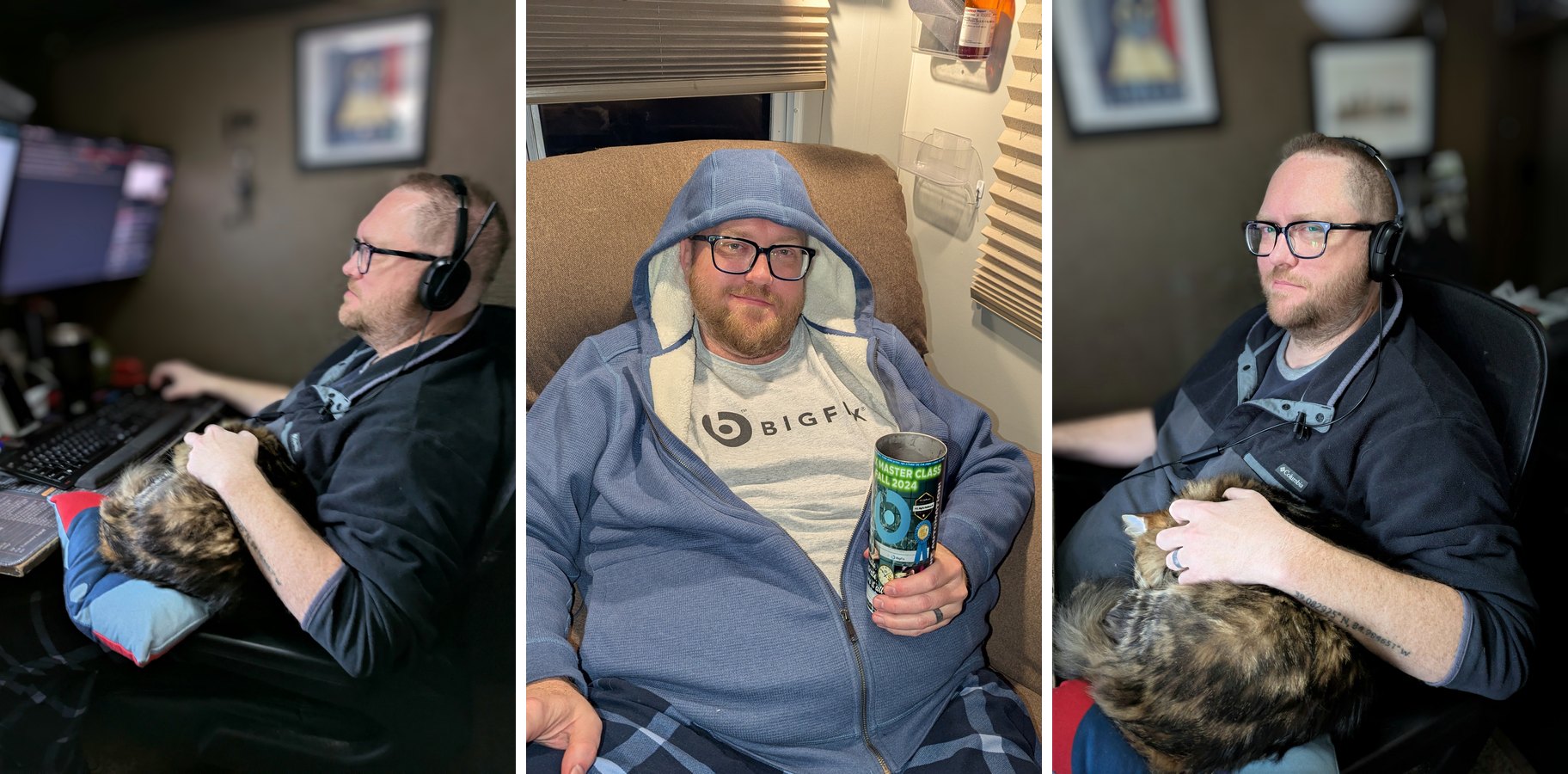
Here is the part with no drama in it at all, which is why it took me twenty months to notice it was the biggest change of my life.
The last several years at HCL Software, my sleep worked like this. I had 9:00 AM Eastern client engagements, which meant video calls, which meant being verbally and visually performative first thing in the morning. To be functional for that I had to be asleep by midnight. To be asleep by midnight I took medication to force it, because my brain had no interest in that configuration and never had. And that was the easy version. My schedule belonged to whichever client I was serving. Most of my work ran on UK or India time, and for one engagement I moved myself onto India Standard Time for an entire week to train a whole team, starting my day at 2 AM. It wrecked my sleep pattern for far longer than the week it took.
And at least two or three nights a week it did not work anyway. I would simply lie there all night, awake, having taken something specifically designed to prevent that outcome, waiting for a 9:00 AM call I would then have to perform through. On the nights it did work I got four to six hours.
So: years of chronic sleep debt, layered under a full-time masking performance, in a schedule built for somebody whose brain is configured differently than mine.
Today I sleep seven to eleven hours, regularly, without pharmaceutical help, because my working hours are built around my actual circadian rhythm instead of somebody else's standup.
That is not a lifestyle upgrade. That is the single largest health intervention of my adult life, and it did not come from a doctor, a prescription, or a diagnosis. It came from removing the requirement to be a morning person.
What the Literature Calls It
The camouflaging literature has been circling this for years. A systematic review and meta-analysis found that camouflaging is linked to increased anxiety, depression, and social anxiety and to lower mental wellbeing, and it describes autistic burnout, as autistic people themselves define it, as a debilitating state of profound exhaustion, loss of skills, and social and occupational withdrawal, often triggered by the demands of living in a neurotypical world. A 2026 scoping review adds that it may not be the act of camouflaging alone, but camouflaging over an extended period or periods of time, that leads to the more severe outcomes.
Nearly thirty years is an extended period.
What I Do With Time Now
The other thing the diagnosis changed is what I am willing to spend time on, and this is the part I would most want the fifteen year old from last week to steal from me.
Before, time was a resource to be optimized toward output. Anything that did not produce something was overhead. That is not a work ethic, that is a masking strategy with a spreadsheet attached.
Now I will spend a whole afternoon cooking. Real food, from scratch, slowly. I will spend time exercising, which for a man with a fused spine is a negotiation rather than a workout. I make time for friends. Remember that thirty-seven minute call? A few days later I had another one, with another old teammate from the BigFix Professional Services bench at HCL Software. Same great ROI. And Karen and I are making up for a lot of time we lost, in the bedroom and out of it, because for years I was too depleted by 8:00 PM to be a person, let alone a husband.
None of that is productive by the metric I used to run. All of it is why I am healthier at fifty than I was at forty.
The Accommodations That Have Made the Biggest Impact
This is the part I actually want you to take away, and it took me twenty months and a therapist to see it.
Some of these were running for decades before anyone tested me. I just called them personality, or preference, or being difficult. The diagnosis did not hand me those. It gave me permission to admit they were load-bearing. The rest are new, and they are the ones I was never allowed to have while I worked for somebody else.
Already in place before the diagnosis
- Music as regulation. Not background noise. A deliberate instrument for managing emotional state and concentration, selected by what I need it to do to me. I have used it this way my whole life and never once thought of it as a coping mechanism until someone told me what I was.
- Written communication, always, by default. Email and SMS over voice, for the reasons at the top of this post. The default is written. The exception is a person who costs me nothing.
- Task capture in systems I trust. Google Tasks for specific recurring use cases, daily, weekly, and monthly items I refuse to leave to memory, and my own file-based second brain for everything with depth to it. Two systems, deliberately, because they do different jobs. This is executive function offloaded to storage, which is exactly what it sounds like.
- BigFox. Our Northwood Mfg Arctic Fox 31D travel trailer is not just where we live. It is a regulated environment, adapted continuously for our location, the weather, and what I need on a given day. It is small, it is ours, and there is nobody in it I have to perform for. I did not build it as an accommodation and I never once described it that way until a conversation forced me to. But that is what it is. It is my nomadic castle, and the reason my nervous system stands down when I walk into it is that Karen and I control the entire configuration.
New since the diagnosis
- Adjusted hours and slow wake-ups, covered above, and worth every dollar they cost me in conventional employability. I never asked for this one while I was employed. After the fight to be allowed to stand up and stretch at my own desk, which is next week's post, I did not think it was worth it.
- Cooking as ritual. I listed this above under time, but it belongs here too. It is sequential, sensory, has a clear end state, and produces something real. That is a regulation exercise that happens to feed us.
- Working on the projects that energize me. For nearly thirty years the work chose me, and I performed my way through whatever it was. Now I pick the problems that light my brain up instead of the ones that drain it. Right now that is three things. Building endpoint security services around Action1 and a few other platforms, so small and mid-sized businesses can get the enterprise-grade protection I spent my career deploying for the Fortune 500. Building KPC-Bot, a local looped service that helps Karen draft social copy for her KPC Unlimited customers. And Sasquatch RV, the off-grid 3D-printed truck camper that 3D Nomadic exists to build. The new services get their own post soon.
- Regular check-ins with Karen. Still the one that matters more than all the others combined, and still the only one that requires another person to volunteer.
Look at both lists and notice what they have in common. None of it required a diagnosis. All of it required permission. The first list I gave myself without knowing I was doing it. The second list I could not give myself while I answered to anyone else, and for forty years the only entity that could have given me permission was an institution that had already decided not to look.
Why I'm Telling You This
Because the most common thing I hear from people who suspect they are neurodivergent and cannot get evaluated is that they are stuck until they get an answer.
You are not entirely stuck. The diagnosis matters enormously, and last week's post is a four thousand word argument for why the system that gatekeeps it is broken. But the diagnosis did not build my sleep schedule. It did not select my music. It did not decide that a phone call from a person I trust is cheap and a phone call from a stranger is expensive. It did not make my nomadic castle a place my nervous system recognizes as safe.
Those things came from paying attention to my own operating conditions and then respecting what I found. For me, the diagnosis did not necessitate any of them. It gave me permission to do them. My hope is that by sharing this, you can start today, uninsured, undiagnosed, and unpermitted, and you should.
Then get loud about the fact that you had to do it alone.
I am fifty. I sleep now. It took forty-eight years, a wife who would not let it go, a therapist who actually looked, and ten thousand dollars I did not have. Next week I am going to tell you exactly what corporate America did with me in the meantime, and I am going to publish the resignation letter I wrote about it, in which I said absolutely none of this. Damn, I wish I had had this perspective then.
If any part of this post landed close to home, in the Beckett Springs sense: in the US you can call or text 988 to reach the Suicide and Crisis Lifeline, any time. I was in that place once, I did not get myself out alone, and there is no version of asking for help that makes you weak.
Sources & Further Reading
- Bradley, Shaw, Baron-Cohen & Cassidy, “Autistic Adults' Experiences of Camouflaging and Its Perceived Impact on Mental Health” (Autism in Adulthood, 2021, via PMC): up to 79% of autistic adults meet criteria for a co-occurring psychiatric condition and up to 66% reported feeling suicidal at some point.
- Cassidy, Bradley, Shaw & Baron-Cohen, “Risk markers for suicidality in autistic adults” (Molecular Autism, 2018, via PMC): in 164 autistic adults, camouflaging significantly predicted suicidality after controlling for age, sex, depression, anxiety, employment, and living arrangements.
- Khudiakova, Russell, Sowden-Carvalho & Surtees, “A systematic review and meta-analysis of mental health outcomes associated with camouflaging in autistic people” (Research in Autism Spectrum Disorders, 2024, ScienceDirect): camouflaging linked to increased anxiety, depression, and social anxiety and lower wellbeing across 5,897 autistic participants; the definition of autistic burnout as profound exhaustion, skill loss, and social and occupational withdrawal; camouflaging described as exhausting, potentially leading to burnout and suicidal ideation.
- Hodge & Meltzoff, “The relationship between autistic camouflaging and mental health: a scoping review” (Frontiers in Psychiatry, June 2026, full text): on camouflaging over an extended period or periods of time leading to the more severe poor mental health outcomes.
- Texas Health and Safety Code § 481.116, Possession of Substance in Penalty Group 2 ( Texas Legislature): under one gram is a state jail felony, one to four grams a third degree felony, four to four hundred grams a second degree felony, four hundred grams or more a first degree felony, graded by aggregate weight including adulterants and dilutants. Tetrahydrocannabinols other than marihuana sit in Penalty Group 2 under § 481.103.
- Texas Penal Code § 12.33, Second Degree Felony Punishment ( Texas.Public.Law): imprisonment for not more than 20 years or less than 2 years, plus a fine of up to $10,000.
- Marijuana Policy Project, “HB 46 expands Compassionate Use Program” ( MPP): signed June 21, 2025, effective September 1, 2025; adds chronic pain, Crohn's, traumatic brain injury, terminal illness, and hospice care as qualifying conditions; permits lotions, patches, suppositories, and inhalation devices including vaporizers; replaces the 1% THC by weight cap with 10 milligrams per dose and 1 gram of THC per package; raw flower remains prohibited.
Sourcing note: the clinical literature and the Texas statutes above were checked before publishing. Everything about my family, my marriage, my hospitalization, my medical history, and my sleep is my firsthand account. My characterization of my former wife is my own assessment of my own experience and is not a clinical claim about a real person, who is not named or identified here. My children are not named, counted, or identified. My former best friend is not named. Verify anything you plan to repeat.
Connect with Casey
If this resonated, or if there's a topic you want me to take on next, reach out. I read everything.
| Websites | |
| @cmcannady | |
| facebook.com/cmcannady | |
| Threads | @cmcannady |
| Bluesky | @cmcannady.bsky.social |
| linkedin.com/in/caseycannady | |
| YouTube | @CaseyCannady |
Casey writes about economic policy, nomadic life, cybersecurity, chronic pain, and navigating the world as a late-diagnosed AuDHD adult. New posts drop on my professional website.