Personal Reasons
Final post in the series: My Default Config Was Neurotypical
By: Casey Cannady : nomad, cybersecurity veteran & late-diagnosed AuDHD adult
TL;DR
I wrote two resignation documents on the same morning, and only one of them was true. The formal letter, dated November 25, 2024, said I was leaving HCL Software after “careful consideration of my career goals and opportunities.” For twenty months I remembered that letter as saying personal reasons. It did not even say that much. At 6:15 that same morning I sent an email to HR, with the letter attached, listing ten actual reasons, including a panic attack that required medication and counseling, a midnight email clawing back thirteen thousand dollars while I was recovering from spinal fusion, having to obtain a medical waiver to schedule breaks to stand up and stretch, and one line I had never said out loud to any employer in nearly thirty years: the culture is not conducive for AuDHD'ers like me. I knew exactly which document would go in the permanent file and which one would be read once and closed. So did they. This is the last post in the series and it is the angry one, and the thing I am angriest about is that I told them, in writing, with bullet points, and nothing happened.
I did not fail to speak up. I spoke up on the way out the door, because that was the only moment corporate America had ever made safe.
Two Documents, Same Morning
On November 25, 2024 I wrote a resignation letter. It was warm and professional. It thanked the Professional Services team, which it should have, because those people were genuinely talented and I meant every word about them. And when it came to why I was leaving, it said this:
“This decision comes after careful consideration of my career goals and opportunities.”
I need to stop here, because that is not the sentence I remembered writing. For twenty months I have carried that letter in my head as saying I was leaving for personal reasons that required my attention and focus. That is what I told people. That is the title of this post. When I pulled the actual document to publish it, the words were not there. What I actually wrote was emptier than what I remembered. Career goals and opportunities. Not even a personal reason, just a category with nothing in it. The mask was so good it fooled the man wearing it.
At 6:15 that same morning I sent an email to HR with the subject line “Resignation,” with the letter attached, noting that I had submitted through the offboarding system and requested my last day. The system would not accept pasted text for my reasons for leaving, and I was not about to retype all of it into a form field, so I put it in the email instead.
Ten bullets, four of them with sub-bullets. Here are the ones this post is about.
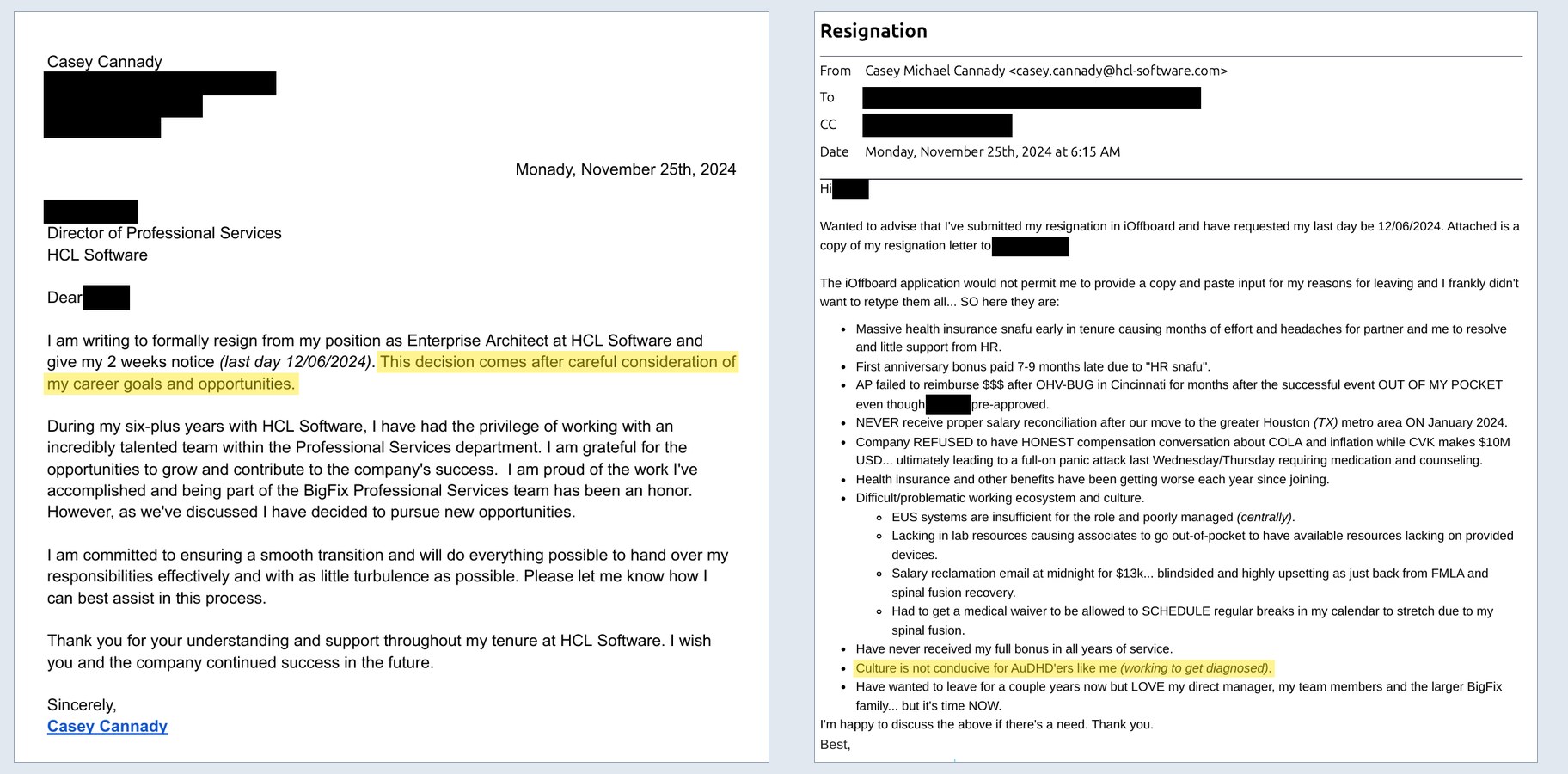
- A refusal to have an honest compensation conversation about cost of living and inflation, while the CEO makes $10M USD, ultimately leading to a full-on panic attack requiring medication and counseling.
- A salary reclamation email at midnight for $13k, blindsiding and highly upsetting, arriving just as I was back from FMLA and spinal fusion recovery.
- Having to get a medical waiver to be allowed to schedule regular breaks in my calendar to stretch due to my spinal fusion.
- Health insurance and benefits getting worse every year since joining.
- “Culture is not conducive for AuDHD'ers like me (working to get diagnosed).”
That last bullet is the reason this post exists.
That was the first time I ever disclosed my AuDHD to an employer. Nearly thirty years in corporate America, across every company I ever worked for, and I had never once put it on the record. Not in an interview, not in a review, not to HR, not anywhere it could be written down.
One person at that company knew anything at all, and even that was not a disclosure. About six weeks before I wrote the resignation letter, I mentioned to my manager, verbally, that I was going to get tested. That is an intent, spoken once, to one human being. It is not the same act as writing down what you are, addressed to the department that keeps the file.
The first time those words left me in a way that could be retained, searched, or acted on was in a bulleted list to HR, after I had already resigned and after my last day was already scheduled.
That is not bravery and it is not a coincidence. That is a man who finally calculated that the disclosure could no longer be used against him, because there was nothing left to take.
What I Said, and What Happened
Nothing happened.
I want to be precise, because I am not alleging misconduct. I am describing architecture, which is the same thing I do when I write about anything else on this site.
I offered in that email to discuss any of it if there was a need. There was no need. The offboarding completed. The account closed. Ten itemized reasons, including a documented panic attack and a disability disclosure, went into a system designed to record that an employee left, not to do anything about why.
That is the exit interview as an institution: a grief-capture mechanism with nothing downstream of it. It exists so the company can say the channel was open. None of it is wired to anything that could change.
Every security professional reading this recognizes the pattern immediately. It is a log with no alerting. You are writing events into a sink.
The COLA, the Panic Attack, and the $10 Million
I asked for a cost of living adjustment. Not a raise for heroics. The arithmetic of not getting quietly poorer every year while rent, groceries, and insurance climbed.
What I got was a refusal to have the conversation honestly, and a question about where I could cut back.
The part I have never published until now is what that did to me physically. My own words to HR at the time: it led to a full-on panic attack, on a Wednesday or Thursday, requiring medication and counseling.
Not a rough week. A medical event, in the same month I resigned, produced by a conversation about whether my pay should keep pace with the price of food.
Now put the other number beside it, because it is public and it is the entire argument. HCLTech's own annual report, as reported by the Press Trust of India, shows CEO C. Vijayakumar earned $10.85 million in FY25: a base salary of $1.96 million, a performance-linked bonus of $1.73 million, and exercised restricted stock units valued at $6.96 million. The board then approved an increase of over 71%, to $18.6 million, for the following year.
I want to be scrupulous here. That is not theft and it is not a scandal. It is a compensation committee doing what compensation committees do, disclosed properly, in a public filing, attached to a market capitalization that genuinely grew.
Which is exactly what makes it worth writing about.
Nobody broke a rule. The rules simply describe two different economic species. When the company's costs rise, that is inflation, and it justifies pricing. When my costs rise, that is a budgeting problem, and I should identify what to give up. Same economic event, two classes of response, determined entirely by which side of the payroll you are standing on. And then the person at the top receives a 71% adjustment for cost of living in a rather different sense of the phrase.
I have written about this machine before, when I called it Leveragism. I did not expect to find my own panic attack inside it.
What My Body Cost Them: Nothing. What It Cost Me: Everything.
This is the part I have been avoiding writing since I left.
In 2022 my right bicep tendon tore away from the elbow. That injury forced my spinal fusion to be rescheduled. And then, before the bicep could be repaired, my L4/L5 disc fully let go.
What followed was the worst pain of my life. Worse than recovering from the fusion itself. Month after month of sitting in a chair or lying in a bed doing the arithmetic of how to get through a single day, on a spine that had structurally failed and an arm that was waiting its turn. It broke me mentally as well as physically, and I am not going to dress that up, because pretending otherwise is the exact reflex this entire series is about.
Nobody should have to hurt that much for that long.
I had the fusion on September 30, 2022. I took FMLA. Here is what was waiting on the way back.
A midnight email reclaiming $13,000 in salary. Blindsided, as I put it to HR at the time, and highly upsetting, arriving while I was still in recovery.
I have mentioned that number several times in this series without ever saying what it was, so here it is. While I was out on FMLA, HCL Software kept paying my salary at the same time the insurance compensation for my leave was paying me, and the two overlapped. That was a payroll error on their side. I have never been told how it happened, and nobody at HCL Software has ever acknowledged that the mistake was theirs. What I got instead was a midnight demand for the overlap back. I had to insist on a repayment schedule instead of a lump sum, and the company then withheld a thousand dollars a month from my paycheck.
It took thirteen months to clear. Thirteen months of a smaller paycheck, starting right after spinal fusion, and running straight into the year I needed a cost of living adjustment and was told the company could not have that conversation.
And a fight to be allowed to stand up.
Here is why that mattered. My work was international. Most of my days ran on UK or India time as well as my own, and most of them were nine to thirteen hours of back-to-back video meetings with clients and internal teams, with minimal breaks between them. A typical session was an hour. Some ran three to five. Camera on or off depended on the customer, but either way you do not stand up and wander off in the middle of a client call. There was no walk from one meeting room to the next, because there were no rooms. One call ended and the next one started. Nobody respected the gap between meetings, because on a virtual calendar there is no gap to respect. And when the meetings finally ended, the actual client work began.
Without a block on the calendar that said I was unavailable, there was no moment in that day when a man with a freshly fused spine could stand up. It was grueling.
I wanted two fifteen minute blocks on my work calendar to stand and stretch, because a calendar block is the only accommodation that actually functions inside a company that runs on scheduling software. If it is not on the calendar, a meeting lands on it.
That request required a medical waiver. It took weeks. It was resolved when my spinal surgeon wrote them a letter.
Now look at what it cost the company. Two calendar blocks. Zero dollars.
The federal data here is not ambiguous. The Job Accommodation Network is funded by the US Department of Labor's Office of Disability Employment Policy, and it surveys employers on precisely this question. Its current reporting, covering 2019 through 2024, found that 61% of workplace accommodations cost the employer nothing at all. Another 33% carried a one-time cost, with a median of $300. Only 6% carried an ongoing cost, with a median of $2,400 a year. And 66% of employers rated the accommodation very or extremely effective. The no-cost share has only grown over the years the survey has run; the Department of Labor's 2023 release on the previous round put it at nearly half.
Mine was in the free bucket.
It still took surgical documentation and weeks of review, at a company whose CEO's compensation that year ran to eight figures, so that a man whose spine had just been fused could be permitted to stand up at his own desk.
That is not a cost decision. Nobody was defending a budget. It is a process performing suspicion, and what it was suspicious of was a fused spine asking for fifteen minutes.
I want to mark this moment carefully, because everything else in this post runs downhill from it.
After the fight to schedule breaks for my spine, I had zero faith that I mattered to that company. Not a grudge. A conclusion, reached from evidence, the way I reach conclusions professionally.
Here is what the evidence said. I had a visible, surgical, radiologically documented, unambiguous disability. Titanium in my back. A surgeon willing to put it on letterhead. The single most legible disability I will ever have, and it still took weeks of process and a doctor's note to get fifteen minutes.
So I ran the obvious extrapolation. If that is what the system does with a fused spine, what does it do with an invisible, undiagnosed, still-being-tested neurological difference that has no imaging, no surgeon, and no letterhead behind it?
I had my answer, and I never had to run the experiment. That was the day I stopped believing disclosure was survivable there.
The Catch-22 That Runs This Entire System
Here is the structural part, and it is why the series ends here instead of somewhere warmer.
Every major corporation I worked for declined the accommodations I asked for, on the grounds that I did not have a diagnosis.
And the one I wanted most, hours that matched my own circadian rhythm instead of a 9 AM Eastern client call, I never asked for at all. In last week's post I listed it as the accommodation worth every dollar it has cost me. After the fight to be allowed to stand up, I did not think it was worth the fight.
Read that against the first post in this series. I could not get a diagnosis because my father would not permit testing, then my own physician asked me what the point would be, then thirteen assessment resources turned me down for being an adult, and then the one that finally said yes cost nearly ten thousand dollars and left half the evaluation unfinished.
The loop closes perfectly:
- The medical system will not evaluate you as an adult, or prices it as though you already have money.
- The employer will not accommodate you without a diagnosis from the system that just declined to give you one.
- You mask harder to survive without accommodation.
- The masking works, which makes your traits less visible to clinicians, which makes step 1 harder.
- Repeat for nearly thirty years, then start vomiting before Monday standups.
Because that is the other thing “career goals and opportunities” was covering. For roughly the year before I resigned, I threw up on Monday mornings. As a pattern. Before sitting down to start the week. Not from anything a doctor would have found on a scan. From years of accumulated sleep debt sitting underneath a full-time masking performance, in a body that had run out of quieter ways to file the complaint.
The research has a name for that neighborhood. A systematic review and meta-analysis found that camouflaging has a significant association with adverse mental health outcomes, and defines autistic burnout as a debilitating state of profound exhaustion, loss of skills, and social and occupational withdrawal, often triggered by the demands of living in a neurotypical world. Reviewers have also noted that it may be camouflaging sustained over extended periods, rather than the act itself, that produces the worst outcomes.
Nearly thirty years is an extended period.
Exactly one person at work knew I was sick every Monday, and only because he found out. He was my best friend, he worked at HCL Software in a different group, and he is the friend I wrote about last week, the one I lost to his church and his Facebook feed. Losing him as a friend was a real gut punch, but his racist and radicalized memes and posts forced me to block his accounts. They were harmful, and he did not want to talk about it.
I am not a lawyer and none of this is legal advice. But I have sat inside enough enterprise compliance programs to recognize a process that is technically defensible and functionally engineered to produce a no. The documentation requirement is the denial. It never has to say no out loud. It only has to cost more than a person already in burnout has left to spend.
“I Knew a Guy Who Fell Apart”
And then there is my manager, which is the hardest part of this to write, because in that same email to HR I wrote that I loved my direct manager, my team members, and the larger BigFix family, and that I had wanted to leave for a couple of years and stayed anyway.
I meant it. I thought the world of him.
He is also the person who, roughly six weeks before I wrote that resignation letter, heard me say I was finally getting tested for AuDHD and urged caution. He said he knew a friend who got tested and broke apart after getting his results.
The timing matters, so hold onto it. That conversation happened in the middle of October 2024. The letter was dated November 25, 2024, about six weeks later. He is the only person at that company who knew the testing was coming, and his response to hearing about it is the last thing I heard on the subject before I sat down and wrote a document that mentioned none of it.
And he is the person who, when I raised cost of living, asked where I could cut back.
I do not think he was being malicious. I think he believed he was looking out for me. That is exactly why it belongs in this post.
Look at what that advice actually does. It takes a man in his late forties who has been trying to get an answer since 2014, who is vomiting before Monday standups, whose spine has just been fused, and it tells him that knowing the truth about himself is the dangerous option. Not the nearly thirty years of undiagnosed burnout. Not the sleep debt. Not the masking. The knowing.
Two conversations, one thesis, delivered by a single person who thought he was being kind: your needs are a budgeting failure, and your self-knowledge is a risk.
He did not invent either position. He absorbed them from an environment that runs on them and passed them along the way you pass along advice you believe in.
Distance has changed how I read it. At the time I filed it as concern from someone senior who cared about me. Twenty months out of corporate America, I am no longer confident whose interests were being protected. I would be perfectly polite to him tomorrow. I could not trust him now.
I got tested anyway. I did not break apart. I sleep now.
Why the Letter Said Nothing
So why did the formal document say nothing?
Because by November 2024 I had a fully trained, fully evidenced model of what happens when a neurodivergent employee tells an employer the truth:
- You ask for a cost of living adjustment and get asked what you can live without.
- You ask for two calendar blocks after spinal fusion and get a compliance process and a demand for surgical documentation.
- You ask for accommodation without a diagnosis and get told to come back with one.
- You go get the diagnosis and your manager warns you it might destroy you.
Given that dataset, “careful consideration of my career goals and opportunities” was not cowardice. It was the correct output of the model. It was me performing, in writing, on the way out, the exact skill nearly three decades of corporate America had trained into me: translate a legitimate need into a vague and unthreatening phrase, then apologize for the inconvenience.
And then, that same morning, with the resignation already filed in the offboarding system and the last day already set, I attached the letter to an email and sent the real one. Ten bullets. The panic attack. The thirteen thousand dollars. The medical waiver to stand up. The culture is not conducive for AuDHD'ers like me.
Two documents, one morning, same man. The gracious one is in the permanent file. The true one went into a system with no alerting.
I have spent nearly thirty years in IT and cyber-security. When a system produces the same output from the same input across every organization you test it against, that is not a bug in one company. That is the specification.
Why I'm Telling You This
Because I want the receipt filed somewhere the next person can find it.
And because HCL Software may be the company I am telling the story about, but it is not the exception. It is the rule. HCL in and of itself was not evil. It was following the rules corporate America wrote for itself and has never been made to rewrite, and I have the receipts from the other companies too. At Creative Breakthrough Inc., a Detroit cyber-security firm where I was the in-house BigFix architect from 2018 to 2019, I had to fight for control of my own travel so that a six-foot-five, 350-pound man was not folded into a coach seat. At Kroger, where I was a senior technology engineer from 2013 to 2018, I once worked thirty-six hours straight, went home to sleep, and was called opportunistic by my manager for it. And us AuDHD'ers? We are rule followers. We follow the rules right up until the rules break us, and then we write a polite letter.
Somewhere right now there is a neurodivergent employee who is very good at their job and running a performance convincing enough that their manager describes them as intense but fine. They are not fine. They are subsidizing an environment built for a different nervous system out of their own health, at a discount rate, and the environment has no idea it is being subsidized, because the entire point of masking is that the invoice never arrives.
To them: your workarounds are not free. Somebody is paying for them and it is you. And when you do finally say it out loud, say it while you still work there, not in the exit email. I said mine with the resignation already filed, too late to matter, and that is the one thing in this series I would do differently.
To anyone with authority over one of them: more than half of the accommodations you are quietly afraid of cost nothing. The median for most of the rest is three hundred dollars. You are not protecting a budget. You are protecting a process, and the process is costing you people. I gave six-plus years and left with a polite letter that told you nothing true and an email that told you everything, and you are finding out which was which at the same time as everyone else.
And to the fifteen year old at Luna Pier who started this whole series by asking about a piece of pita: this is what is waiting on the other side of the diagnosis they are making you wait until eighteen to get. Not a cure. Not a fix. A word, and then the right to use it. Get the word. Then use it out loud, earlier and louder than I did, because the nearly thirty years I spent not saying it cost me far more than the saying ever would have.
That is the series. Nothing about me was broken. My default config was neurotypical, and I finally stopped running someone else's build.
Disclosure
I worked at HCL Software for six-plus years as an Enterprise Architect in the BigFix Professional Services organization. I submitted my formal resignation letter on October 24, 2024, and my email to HR itemizing my reasons on November 25, 2024. I left in the first week of December 2024, and my health coverage ended December 31, 2024. I have been uninsured since January 1, 2025.
I hold no current employment relationship with HCL Software, no ongoing compensation, no equity, and no non-disparagement agreement covering this material. I am a certified BigFix practitioner and I have worked with BigFix professionally as an independent consultant, which means I have a continuing commercial interest in the product ecosystem HCL operates in. Readers should weigh that.
My criticism here is aimed at policies, processes, defaults, and publicly disclosed executive compensation, not at individuals. My former manager, my former HR contact, and my former colleagues are not named. The documents reproduced above are my own, and personal contact details and third-party names have been redacted from them.
Sources & Further Reading
- Job Accommodation Network, “Costs and Benefits of Accommodations” (funded by the US Department of Labor's Office of Disability Employment Policy, askjan.org): employer survey covering January 1, 2019 through December 31, 2024. 61% of accommodations cost nothing to implement; 33% carried a one-time cost with a median of $300; 6% carried an ongoing cost with a median of $2,400 a year; 66% of employers rated the accommodation very or extremely effective.
- US Department of Labor, “US Department of Labor announces report finding nearly half of accommodations for disabled workers have no cost” (May 4, 2023, dol.gov): the previous survey round, for the trend.
- Press Trust of India via Business Standard, “HCLTech CEO Vijayakumar earns $10.85 mn in FY25; tops TCS, Infosys heads” (August 3, 2025, Business Standard), citing HCLTech's annual report: total remuneration of $10.85 million for the fiscal year ended March 31, 2025, comprising a $1.96 million base salary, a $1.73 million performance-linked bonus, $6.96 million in exercised RSUs, and $0.20 million in benefits and perquisites, with a board-approved increase of over 71% to $18.6 million for the following year.
- Khudiakova, Russell, Sowden-Carvalho & Surtees, “A systematic review and meta-analysis of mental health outcomes associated with camouflaging in autistic people” (Research in Autism Spectrum Disorders, 2024, ScienceDirect): significant association between camouflaging and adverse mental health outcomes, and the working definition of autistic burnout.
- Hodge & Meltzoff, “The relationship between autistic camouflaging and mental health: a scoping review” (Frontiers in Psychiatry, June 2026, full text): on camouflaging sustained over extended periods producing the most severe outcomes.
- Previous posts in this series: “You've Done This Well So Far. What's the Point?” and “I Sleep Now”.
Sourcing note: the accommodation cost figures come from the Job Accommodation Network, a US Department of Labor funded service. The executive compensation figures come from HCLTech's own annual report as reported by the financial press. Both were checked before publishing. Everything about my employment, my surgeries, my health, my resignation, and the conversations described here is my firsthand account, and the two documents quoted are my own. My former manager and my former best friend are not named. I am not a lawyer and nothing here is legal advice about the ADA or any employer's obligations. Verify anything you plan to repeat.
Connect with Casey
If this resonated, or if there's a topic you want me to take on next, reach out. I read everything.
| Websites | |
| @cmcannady | |
| facebook.com/cmcannady | |
| Threads | @cmcannady |
| Bluesky | @cmcannady.bsky.social |
| linkedin.com/in/caseycannady | |
| YouTube | @CaseyCannady |
Casey writes about economic policy, nomadic life, cybersecurity, chronic pain, and navigating the world as a late-diagnosed AuDHD adult. New posts drop on my professional website.