You've Done This Well So Far. What's the Point?
First in a new series: My Default Config Was Neurotypical
By: Casey Cannady : nomad, cybersecurity veteran & late-diagnosed AuDHD adult
TL;DR
I was IQ tested at eight years old, flagged as highly intelligent, and then left alone for forty years. My younger brother was diagnosed with ADD as a kid. My younger sister was diagnosed with ADHD as a kid. My father would not allow me to be tested. In August 2014, at my wife Karen's urging, I finally asked my own doctor about getting evaluated for Asperger's, and with Karen sitting right there he asked me what the point would be, since I had done this well so far. I stayed with him anyway. Ten years later I emailed every autism assessment resource I could locate within driving distance, roughly thirteen of them, and every single one turned me down, mostly for being too old or for the insurance math. Karen and I drove from Rochester, New York to New York City and I got tested on December 16, 2024, eleven days after my last day at HCL Software and fifteen days before my health coverage expired. It cost nearly ten thousand dollars after insurance, including travel. I was forty-eight. The tests confirmed what my therapist and I had already worked out together. The autism half of that evaluation is still unfinished, because I have been uninsured since January 1, 2025 and I cannot afford to buy the rest of the answer. This is post one in a new series, and it starts on a beach in Michigan with a fifteen year old girl who is at the very beginning of the exact same road.
Being smart was not evidence that I was fine. It was the reason nobody checked.
Last Thursday, Luna Pier
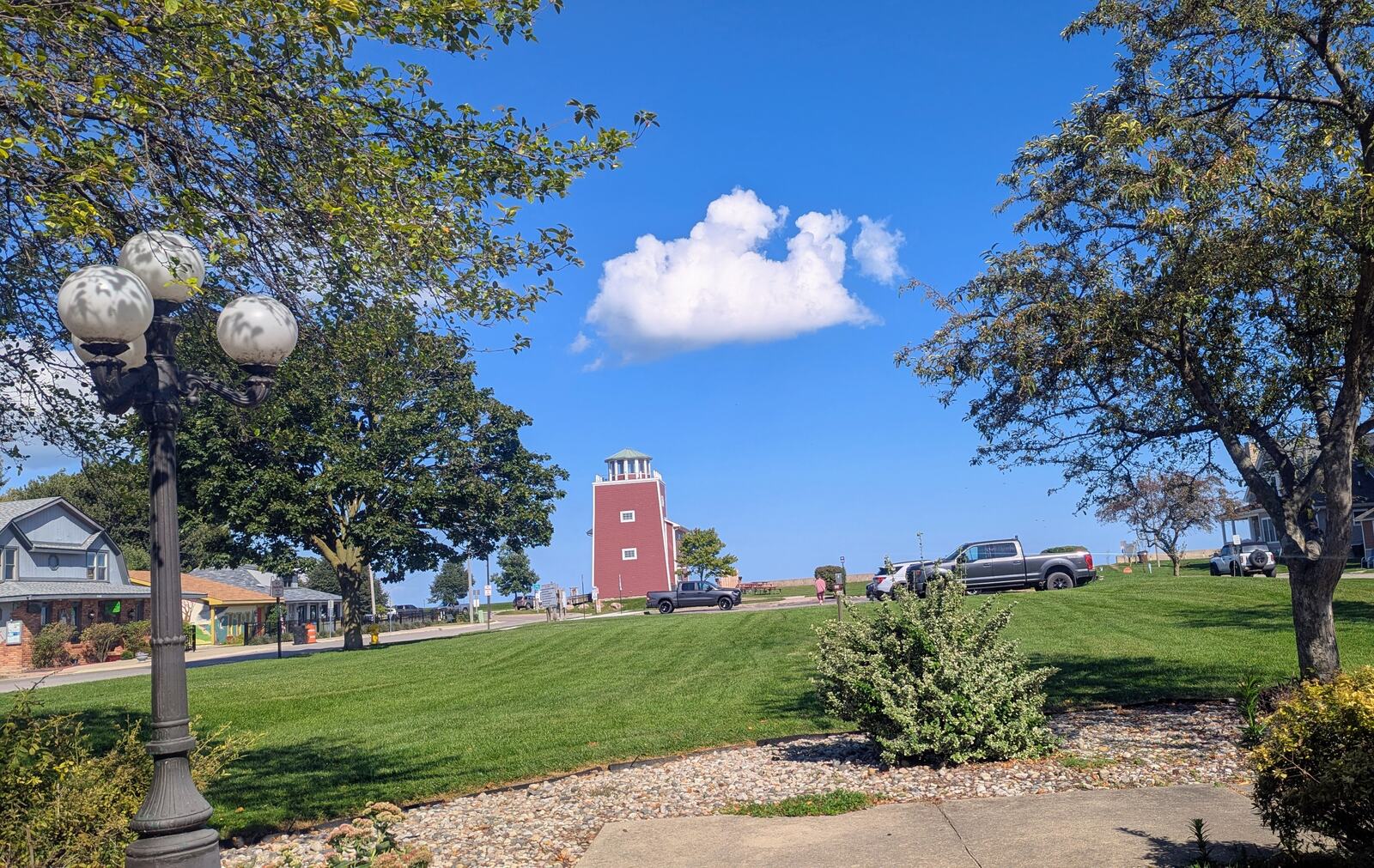
Karen and I packed homemade hummus, a bag of pita, some drinks, and the camping chairs, and we drove to the beach-side park at Luna Pier, Michigan. Blue sky, one absurd postcard cloud, the kind of day that makes a full-time nomad feel like the whole gamble paid off.
We walked out the pier and back before we did anything else, and it was completely uneventful, which is exactly what I want on a day like that. Karen spent half of it on the phone with her cousin. We came back to the truck hand in hand, collected the chairs, and set up over in the park. We stayed more than four hours.
Near the end of it, a girl walked past our chairs and asked about the pita.
That is the entire inciting incident. A teenager wanted to know what the flatbread was.
She was fifteen. Her grandmother, sixty-seven, was with her, and the two of them had been on their way out. They did not leave for another hour.
Somewhere in that first minute I mentioned that I am autistic. She said she is ADHD. And then I started watching, because what I was seeing across from me was not just ADHD. It was me at fifteen, right down to the way she was holding herself in the conversation.
So I started asking questions. Not a checklist. Not an interrogation. Just a guy asking a kid about her own head.
Here is my favorite one, and you should feel free to steal it:
Close your eyes and pretend your thoughts are browser tabs. Do you have a few open, or a few hundred?
She did not hesitate.
There were dozens more like that, and one after another they came back the same way. Not “yeah I guess” but “wait, how did you know that.” She talked about her little brother. She talked about school. Not one single thing she said was proof of anything on its own, and I want to be precise about that, because I am not a clinician and I will not pretend to be one. It was the pattern, the way a dozen small signals stacked into a shape I have spent two years learning to recognize in myself. (She told me, as we parted ways, that I should be a therapist. I am not that either.)
She is a mini me. I would bet real money on it, and I do not have real money.
Then the grandmother told me the part that has been sitting in my chest ever since.
The girl has her ADHD diagnosis. She does not have an autism evaluation, and she is not going to get one, because her biological mother will not permit it. Grandma has tried. The father is incarcerated and is not a guardian. She cannot get guardianship herself. She has been told, effectively, that the girl waits until she is eighteen.
Three years. To a fifteen year old, three years is not a waiting period. It is the rest of high school. It is the rest of her opportunity to receive accommodations and adapt to them before she hits the real world. It is the rest of her opportunity to learn to advocate for herself inside a safe and supportive environment, the one place where needing other people to advocate for you is not just accepted but expected. And it is what can feel like an entire lifetime.
And the reason the adults around her are comfortable with that wait is the reason I want you to remember for the rest of this article: the kid is obviously bright. She is highly intelligent and she is struggling in school, and the adults have resolved that contradiction by deciding she is fine and probably just needs to apply herself.
I know that sentence. It was said about me in 1984.
They left with a lot of kind words and we swapped contact info. The grandmother thanked me more times than was necessary. The girl looked happy, in the specific way a person looks when they feel like someone finally understood.
I drove back to the BigFox and I was not happy. I was furious.
Because I am fifty years old, and I got my answer at forty-eight, and I had to buy it.
What Being Smart Actually Cost Me
I was IQ tested at eight years old. I was flagged as highly intelligent.
That was the end of it. That was the whole intervention.
Here is the part that has taken me four decades to be able to say without flinching. My brother, two years younger than me, has his ADD diagnosis from childhood. My sister, eleven years younger, has her ADHD diagnosis from childhood. Two out of three kids in that house got evaluated, got a name for what was happening, and got it early enough for it to matter.
I got a number and a shrug.
Let me put some outside evidence next to my resentment, because resentment alone is not an argument.
The average age of an ADHD diagnosis in American children sits at right about seven or eight years old. CDC data put it at eight for mild presentations, seven for moderate, and five for severe. I was eight, sitting in front of a psychologist, being formally assessed. I was inside the window. I was in the actual room where this is supposed to get caught.
And here is the mechanism that explains why it did not, and it is the single most infuriating fact in this entire piece. Clinical literature on diagnosing autism in adults names it directly: one of the reasons autism gets missed in childhood is that people who are intellectually average or above require less educational support, and educational support is exactly where these traits usually get noticed.
Read that again, because it is the whole con in one sentence.
The test score that proved something interesting was going on in my head is the same test score that guaranteed nobody would look any further. I was not struggling loudly enough to be a problem. I was struggling quietly, at a high level, and quiet struggle at a high level does not generate a referral. It generates a comment on a report card about not working to potential.
Being gifted did not get me help. It got me disqualified from help.
That is what was happening across from me at Luna Pier last Thursday, forty-two years later, to a fifteen year old girl with the same profile. Nothing about the system has changed. It just got a new kid.
The First Clinic That Turned Me Down Was My Own House
My father would not allow me to be tested for ADHD.
Not could not. Would not. He was asked, the option was on the table, and he refused it.
I have spent a long time trying to build a theory that lets me hold that fact without it eating me. The one I have landed on has two branches, and I cannot prove either, so I will label it exactly as what it is: my best guess about a man I am related to.
Either he was a narcissist, or he was undiagnosed autistic himself and hated what he saw.
Both roads arrive at the same place. A diagnosis in his oldest son would have been a mirror, and he was not going to look into it. My brother's diagnosis was safe. My sister's diagnosis was safe. Mine was the one that would have pointed back at him.
So he traded my next forty years for his own comfort, and it worked, and he never had to see the invoice.
My mother was there. She did not participate and she did not intervene. Bystander. No spine. I have made my peace with saying that plainly, because softening it would be another form of the same protection they extended to him and never extended to me.
And he did not simply withhold the evaluation. He was physically and mentally abusive, and the specific shape of that abuse is the reason the next section of this article exists.
He hit me on the head when I failed to hold eye contact with an adult during a conversation.
That is not a metaphor and it is not a rough patch in an otherwise fine childhood. That is operant conditioning, run on a small autistic boy, by the one person who had decided that boy would never be told what he was. He would not let anyone name the trait, and then he beat the trait out of the visible layer.
It worked. God help me, it worked beautifully.
I am not writing this to litigate my childhood in public. I am writing it because the first gatekeeper in almost every late-diagnosis story is not a doctor or an insurance company. It is a parent. Mine was my father in 1984. Hers is her mother in 2026. The paperwork is different. The mechanism is identical: an adult with legal authority decides that the child does not get to know, and the child has no standing to argue.
Ninja-Level Masking, and Who Trained It
Here is where I have to admit that I got very, very good at hiding it, and that everyone around me rewarded it.
Three years in the Purdue Varsity Glee Club. Then nearly 30 years in enterprise IT and cybersecurity: Fortune 500 environments, federal-scale deployments, rooms full of executives who needed to be told bad news gently. I learned to run a conversation like a script with branches. I learned to hold eye contact on a count. I learned to suppress every stim until I got to the truck.
I got so fluent at performing neurotypical that people who sat next to me for years would tell you I am just an intense guy who talks fast.
That is not a personality quirk. That is nearly three decades of continuous professional-grade performance, built on a foundation my father installed with his hand. The eye contact I can hold indefinitely in a boardroom is the same eye contact he hit me over. I did not develop a coping skill. I was trained, and then I spent nearly 30 years getting paid for the training.
Corporate America bought that performance at a premium. It never once asked what it cost to run, or who taught it to me.
And then there is the second bill, which nobody warned me about.
Research on camouflaging is direct about this: if a person masks effectively during a clinical observation, the clinician may fail to recognize the extent of their traits, and may not make the diagnosis at all. The skill is so effective that it defeats the assessment designed to detect the thing the skill is hiding.
Sit with the loop there. I was never diagnosed as a kid, so I built the mask to survive. The mask worked, so I never got diagnosed as an adult. The better I got at coping without help, the more thoroughly I disqualified myself from receiving any.
My masking is not a party trick. It is scar tissue that grew over an injury nobody treated, and then the scar tissue got listed on my resume.
August 2014: My Own Doctor Closed the Door
I need to give credit where it belongs, and it does not belong to me.
Karen told me I was Asperger's when we first met. Early. Long before 2014. She watched me for a while, put it together, and said it out loud.
I did not take it well. I will not dress that up. My wife handed me an accurate observation about my own neurology and I reacted badly, because a diagnosis had been the forbidden thing in my house since I was eight years old and I had thoroughly internalized why. She was patient with me about it in a way I did not earn.
She kept at it for years. August 2014 happened because Karen pushed me to go ask. Left to myself I would have kept not asking indefinitely.
So I brought it to the person you are supposed to bring it to. My primary care physician. Not a stranger. A long-time PCP, a man who had my whole chart, my whole history, years of relationship.
Karen was in the room with me.
I asked about getting tested for Asperger's.
He discouraged it. And the reason he gave is the reason this article has the title it has:
You've done this well so far. What's the point?
I want to break that down, because it is a masterpiece of a sentence and every word in it is doing damage.
You've done this well so far. That is my masking being read back to me as evidence that I do not need help. The coping mechanism I built because nobody helped me became the proof that I did not require helping. The scar tissue got entered into the medical record as a clean bill of health.
What's the point. That is a doctor telling a patient that an accurate understanding of his own neurology has no clinical value. Not “here is why the evaluation would be hard to get.” Not “here is what it costs and here is who does it.” Just: why bother.
He was not cruel about it. I want to be fair to him. He was casual. He said it the way you would tell someone not to bother replacing a part that still mostly works. That casualness is the part I cannot forgive, because he was closing a door on a decade of my life and it did not cost him enough attention to remember saying it.
There were two of us in that room who heard it. This is not a thing I reconstructed years later or improved in the retelling. Karen was sitting right there, she had spent years getting me into that chair, and she watched a physician wave the whole question away in one sentence.
And here is the thing I have to own, because this is my blog and not a press release: I stayed with him. For years. I took that answer and I filed it and I went back for my physicals like nothing had happened, because he was my doctor and doctors know things and I had been trained my whole life to accept a no from an adult with credentials.
He eventually moved away. I never got a different answer out of him. I just aged out of his practice geographically instead of clinically, which given how this story goes is almost funny.
Ten years. One casual sentence from a man I trusted. That is the whole cost.
The Professional Who Got There Second
Karen got there first. The professional who got there second was my therapist.
Not a clinic. Not an intake questionnaire. A therapist who sat with me long enough and listened carefully enough to say the words out loud, and then had the patience to work through them with me while I argued with her about it, which I absolutely did. Same argument I picked with my wife, years earlier, for the same reasons.
She is the reason I know what I am. Everything that came after, the emails, the drive, the money, all of it was verification, not discovery. The tests did not tell me anything she and I had not already worked out together over months of hard conversations.
I want that on the record, because there is a story people tell where the clinical evaluation is the moment of truth and everything before it is just suspicion. That is backwards. The evaluation is the receipt. The truth showed up earlier, in a quiet room, from a professional who was willing to actually look.
Thirteen Clinics
Then I tried to buy the receipt, and I found out what that actually takes in this country.
I do not make phone calls. I have not for years, and by the time you get to the end of this article you will understand that it is an accommodation and not an affectation. So I did it the way I do everything: I emailed every autism assessment resource I could locate within driving distance. Every single one I could find.
Roughly thirteen of them. A baker's dozen of nos, in writing.
The reasons sorted into two buckets, over and over:
- Too old. The practice only assessed children and adolescents.
- Insurance. Adult diagnostic evaluation was not a covered service.
I am not naming them, and I could, because I still have the correspondence. I am leaving them anonymous because naming thirteen individual practices would turn a structural failure into a story about thirteen unhelpful front desks, and that is exactly the wrong lesson. Nobody was being lazy. They were accurately describing a system they did not build.
Cleveland Clinic says the quiet part in its own patient-facing material: many autism centers are primarily child-focused, so people age out of them on the way into adulthood, and finding support becomes a serious problem. That is not a disgruntled patient on Reddit. That is a major hospital system describing the gap as a known feature of the landscape.
Which means my thirteen rejections were not bad luck. They were the system running correctly, as designed, doing precisely what it was built to do, which is serve children and hand adults a shrug.
I spent nearly 30 years in security learning to recognize the difference between a broken system and a system whose design simply never included you. This was the second kind. There was no bug to report. I was just not in the requirements document.
New York City, December 16, 2024
Look at the calendar with me, because the calendar is the story.
- December 5, 2024: my last day at HCL Software.
- December 16, 2024: my evaluation in New York City.
- December 31, 2024: my HCL health coverage expires.
- January 1, 2025: I become uninsured, and I have been uninsured every day since.
I got tested inside a twenty-six-day window, on a health insurance card that was already dead and just had not stopped moving yet.
Karen and I drove it, from Rochester, New York down to New York City, because after thirteen written nos the one yes I could find was at the far end of the state and I was not going to let it get away.
Total cost, after insurance, including the travel to get there: nearly ten thousand dollars. For a man who would file Chapter 7 the following October.
If that number sounds insane, here is the context that makes it worse, because it means I did not even get overcharged.
Current market pricing for adult autism evaluations runs roughly two to five thousand dollars without insurance, and a full neuropsychological battery from a neuropsychologist can run three to nine thousand. And the detail that explains my entire experience in one line: insurance covers adult diagnostic evaluations far less consistently than it covers children's evaluations, even in states that have autism insurance mandates on the books.
So the mandate exists. It just does not reliably reach a forty-eight year old man. Same condition, same tests, same clinicians. Different birthday, different answer from the insurer.
I was not gouged. I paid the going rate for being an adult who wanted to know.
The Half I Could Not Afford
The New York clinic was prepared to do the additional autism testing. They were willing. They had the capability. That part was on the table.
It came down to money, and I did not have any more of it.
So I walked out of that building in December 2024 with a formal ADHD diagnosis at forty-eight years old and an incomplete autism evaluation, and that is exactly where I still sit today, twenty months later. My AuDHD is not some cute self-applied label I picked up on TikTok. It is one confirmed diagnosis and one evaluation that got cut off at the checkout screen.
Finishing it would cost thousands. I have been uninsured since New Year's Day 2025. We filed Chapter 7 in October of that year. The math is not complicated and there is no clever workaround in it.
And one more thing belongs in this section, because it is the reason the unfinished half is not a hole in my life. My therapist could never have formally diagnosed me in the first place. She is not a doctor, so that signature was never hers to give, no matter how right she was. I trust her read on me more than I trust any of the credentialed people who did hold that authority and declined to use it. What I bought in New York was the signature. She had already given me the answer.
Diagnosed enough to know. Not solvent enough to finish.
I Took the Answer. I Did Not Take the Pills.
They prescribed medication. I did not take it.
I need to be careful here, because I know exactly how that reads, and I am not what you probably just assumed I am. I am not anti-medication and I am not anti-science.
Here is my actual history with pharmaceuticals. At the time of my spinal fusion I was taking nineteen prescriptions a day, plus a weekly injectable. Today I am down to five, and my health has improved by every measurement that exists. That did not happen because pills are evil. It happened because the American healthcare system had built a structure around me where each new prescription managed a side effect of the last one, and nobody in that chain had any incentive to stop and ask whether the tower needed to come down.
Nineteen medications a day is more profitable than five. Full stop. That is not a conspiracy theory, that is arithmetic, and I lived on the wrong side of it for a decade.
So when a new diagnosis at forty-eight came with a new prescription pad, I made a different call this time. I went back to my therapist and we built the other thing instead: regulation and coping tools, plus the accommodations I actually need in order to function.
What that looks like in practice, on the road, in a travel trailer:
- Adjusted hours built around my real circadian rhythm instead of somebody's 9 AM standup.
- Slow wake-ups. Not a luxury. The difference between a usable day and a wasted one.
- No phone calls. Email, SMS, or video. Voice-only calls burn processing capacity I need for the actual work, and I stopped apologizing for that. This is the accommodation people push back on hardest, and it is the one I will defend the longest. I ran the entire search for my own diagnosis over email because of it, and I found my answer anyway.
- Micro-dosing cannabis, during my waking hours, to slow my brain down enough to be present in it. I have written at length about what cannabis did for my chronic pain. This is the other half of that story, and I will get into it in depth in its own post.
- Specific supplements with known relevance to AuDHD.
- Regular check-ins with Karen, which is the accommodation that matters more than all the rest combined, and the only one that requires another human being to volunteer for it.
That stack works. I want to be honest about why it works: it works because I am not in corporate America anymore. Every item on that list would have been a negotiation, a disclosure, and a quiet mark against me at any employer I ever had. I did not build a better life. I built a life small enough and independent enough that I could set my own configuration without asking permission.
That is not a triumph. It is a workaround. And this is my path, not a prescription for yours. If medication is what gets you functional, take the medication and do not let anyone, including me, make you feel strange about it.
What I Would (and Did) Say to a Fifteen Year Old
I am not making a policy demand today. No bill number, no ask for your congressman. That is not what this one is for.
This one is for the kid on the grass at Luna Pier, and for the grandmother who is doing everything she can with no legal standing to do it.
Being smart is not the same as being fine. If you are highly intelligent and drowning in school, those two facts do not cancel out. The intelligence is not evidence against you needing help. In my case and in the clinical literature both, it is the single most common reason help never arrives.
A no from a gatekeeper is not a diagnosis. My father's no was not a diagnosis. My doctor's no in 2014 was not a diagnosis. Thirteen clinics saying no was not a diagnosis. Every one of those nos was an administrative event, and I spent forty years treating them like medical findings.
And to the grandmother, because I have thought about your situation every day since: you are not wrong and you are not powerless, you are just blocked on the one door everyone keeps pointing at. So work a different one. Adult diagnosis requires establishing that the traits were present in early development, and that evidence gets reconstructed later from school records, teacher comments, developmental history, and the person's own account. That evidence is being generated right now, and it is the thing that decays. Keep the report cards. Keep the emails from teachers. Encourage her to keep her own notes, in her own words, about what her head actually does.
Three years from now, when she turns eighteen and can finally consent to her own evaluation without asking anyone's permission, that box of paper is the difference between a fast assessment and my ten thousand dollar version.
She should not have to wait. She is going to have to wait anyway. So let us at least make sure she is not starting from zero on her birthday.
Why I'm Telling You This
Because I want the invoice on the record.
Three tiers of adult authority told me no. My father, who would not permit it and who hit me until the evidence stopped showing. My doctor, who could not see the point, with my wife sitting next to me. Thirteen clinics, who could not fit an adult into a system built for children. Every one of those nos was cheap for the person delivering it and expensive beyond calculating for me.
Forty years of not knowing why I am the way I am. A career built on a mask I did not choose and did not develop, but was taught, by hand, before I was old enough to know what was being taken. And then, at the end of all of it, a ten thousand dollar bill for confirmation, eleven days after my last day of work, and half the answer left behind at the counter because I ran out of money before I ran out of questions.
The only reason I got any of it is Karen. She named it first, she absorbed my ugly reaction to being named, she pushed me into that exam room in 2014, she sat there while a doctor waved it off, and ten years later she drove me across New York State to go get it anyway. Every institution in this story failed. One person did not.
The title of this series is My Default Config Was Neurotypical, and I mean that with all the precision my day job gives me. Nothing about me was broken. The base configuration was simply written for somebody else, and every institution I passed through validated me against that config, marked me as passing, and moved on. Schools do it. Doctors do it. Employers do it. They all check you against a default that was never you, and when your workarounds are good enough to fake the result, they file you under fine.
I am fifty. I got my answer at forty-eight and I had to buy it.
She is fifteen. She should not have to.
Watch for the next two posts in this series, and in the meantime, if you are the smart kid who was never fine: you were not lazy, you were not dramatic, and you were not making it up. You were undiagnosed. There is a difference, and you deserved to be told it a very long time ago.
Sources & Further Reading
- CDC: data on average age of ADHD diagnosis in children, reported at 8 for mild, 7 for moderate, and 5 for severe presentations.
- CDC / National Center for Health Statistics Rapid Surveys System (2023): an estimated 15.5 million US adults had a current ADHD diagnosis, and 55.9% of them received that diagnosis in adulthood.
- Cleveland Clinic: patient guidance on pursuing an adult autism diagnosis, including the acknowledgment that many autism centers are primarily child-focused and that adults age out of them.
- “Diagnosing Autism in Adults: Clinically Focused Recommendations” (PMC): on why autism is missed in childhood, including that individuals who are intellectually average or above require less educational support, which is where symptoms are commonly noticed.
- Research on camouflaging in autistic adults (PMC): on how effective masking during clinical observation can prevent a clinician from recognizing the extent of a person's traits, and therefore from diagnosing.
- Current market pricing for adult autism evaluations: roughly $2,000 to $5,000 without insurance, with full neuropsychological batteries running $3,000 to $9,000, and adult diagnostic evaluations covered less consistently by insurance than children's evaluations even in states with autism mandates.
- DSM-5-TR Criterion C: requires that traits be present in early development, which is why school records, developmental history, and retrospective accounts matter so much for adults seeking evaluation.
Sourcing note: every clinical and cost figure above was checked against the sources listed before publishing. Everything about my own family, my own medical history, my own money, and the conversation at Luna Pier is my firsthand account. My characterization of my father's motives is explicitly labeled in the text as my own guess, because it is. The girl and her grandmother are anonymous by my choice and are not identified in any way. Verify anything you plan to repeat.
Connect with Casey
If this resonated, or if there's a topic you want me to take on next, reach out. I read everything.
| Websites | |
| @cmcannady | |
| facebook.com/cmcannady | |
| Threads | @cmcannady |
| Bluesky | @cmcannady.bsky.social |
| linkedin.com/in/caseycannady | |
| YouTube | @CaseyCannady |
Casey writes about economic policy, nomadic life, cybersecurity, chronic pain, and navigating the world as a late-diagnosed AuDHD adult. New posts drop on my professional website.